Buying Your First Motorhome: Tips for Choosing Right
When you stand in front of a motorhome for the first time, you often think first of colour, length or the big fridge. What matters, though, is something else: does the vehicle suit your trips, your everyday life and your budget? Our tips for buying your first motorhome help you find, from the large choice, exactly the motorhome you can set off in with ease – and enjoy travelling in for the long term.
Buying your first motorhome: tips that protect you from bad buys
A motorhome is not a purchase for a single summer. It should cope with weekend trips to the Moselle just as well as a family holiday on the Adriatic, perhaps a visit to friends or a trip with the dog. That is why a good purchase decision does not start with the brochure, but with an honest question: how do you really want to travel?
Do you mostly travel as a couple and look for flexible pitches? Then a compact panel van can be just right. If children come along, sleeping berths, storage and a practical living area often count for more than any design detail. If you want to spend longer periods in the vehicle, you will appreciate a generous bathroom, a comfortable seating area and enough room for clothes, provisions and camping furniture.
The time of year plays a part too. Pure summer trips call for different requirements than trips in spring, autumn or winter. Good insulation, a powerful heater and heated tanks can then make the difference between cosy and unpleasant.
Hire first or buy straight away?
A hire trip is not a must, but for many beginners it is a very smart test drive under real conditions. After a week on the road, you usually know better whether you prefer to travel compact or want more living space, whether you need a fixed bed and how much storage you actually need. Families in particular quickly notice whether the chosen layout works in the morning and when it rains.
If you already know exactly how and where you want to travel, you can also buy straight away. What matters then is advice that looks not only at the vehicles available, but at your requirements. A motorhome should be fun, but it should also stay practical.
The layout decides every day of your trip
The layout is more important than the number of berths in the advert. Take a calm look at the vehicle and play through typical situations: one person is cooking, the other wants to get to the bathroom, the children are sitting at the table, and it is raining outside. Can everyone get past each other easily? Can you use the cupboards, fridge and bathroom comfortably?
For couples, single beds at the rear are popular because each has their own sleeping area and a large bed surface can often be made up. A French bed saves vehicle length but can be less comfortable when getting up in the night. Families should make sure the whole seating area does not have to be converted into a bed every evening. Bunk beds or a drop-down bed can make everyday life much easier.
Take measurements: does your height fit the bed? Is the standing height comfortable? Can you sit comfortably on the bench seat? Tall people and dog owners in particular should not rely on photos alone. A few minutes in the vehicle tell you more than many equipment lists.
Panel van, semi-integrated or fully integrated?
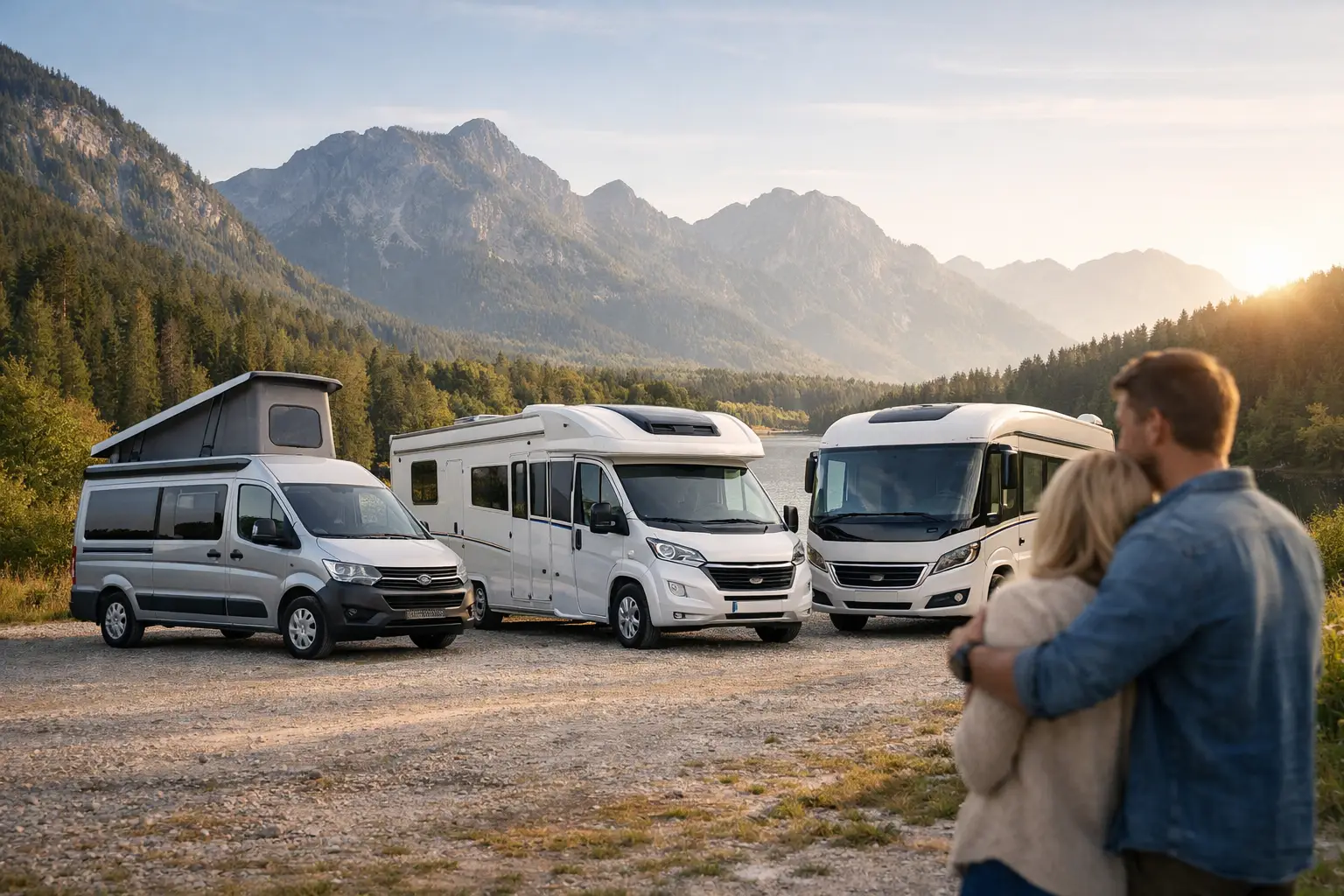
Every body type has its strengths. The panel van is manoeuvrable, relatively compact and often easier to park. It suits couples, solo travellers and anyone who likes to be spontaneous. Inside, however, space is more limited – especially with several people or on longer rainy days.
Semi-integrated models usually offer more living comfort and storage while keeping external dimensions easy to handle. For many couples and families they are a strong compromise between drivability and space. A fully integrated motorhome often creates the most generous sense of space and a wide windscreen with a great view. In return, the purchase price, dimensions and, depending on the model, the weight go up.
There is no single best body type. What matters is whether you love narrow old towns, small pitches and spontaneous excursions, or prefer to stay in one place for a long time and live as comfortably as possible.
Plan your budget properly: don't look only at the purchase price
The purchase price is the biggest item, but not the only one. Deliberately plan a reserve so that the first season is not full of unexpected expenses. Besides insurance, tax and registration, the calculation also includes servicing, leak testing, tyres, gas inspection and parking or storage costs.
Depending on the vehicle and your wishes, retrofits come on top: bike rack, awning, solar system, reversing camera, satellite system or additional battery capacity. You do not need everything straight away. It is often wiser to wait for the first trips and then retrofit accessories selectively, rather than equipping the vehicle from the start with things that are hardly used later.
With used motorhomes, paying somewhat more for an inspected vehicle can make more sense than a supposed bargain with an unclear history. Service records, traceable maintenance and a well-kept body give you security. Ask to be told what work was last carried out and when the next appointments are due.
Check weight, driving licence and payload honestly
Many prospective buyers only look at the maximum permissible mass once the vehicle is almost decided. Yet it determines what you may legally and comfortably take with you. With a category B driving licence, most drivers may drive vehicles up to 3.5 tonnes maximum permissible mass. Above that, a different licence category may be required.
Payload is the difference between the actual mass of the vehicle ready to drive and the maximum permissible mass. It is not only clothes and food that come off this, but also fellow travellers, fresh water, gas cylinders, camping chairs, bikes and accessories. For families in particular, it can get tight faster than expected.
Ask to be shown the specific vehicle weight and the remaining payload. Catalogue figures are a guide, but optional extras change the actual weight. Anyone who wants to travel with four people and bikes needs a different reserve than a couple who mostly packs light and stays at pitches.
Look closely at a used motorhome
A well-kept used motorhome can be an excellent way in. Age and mileage alone, however, do not tell the whole story. Much more important are condition, servicing and a dry, sealed body.
When viewing, pay attention to these points:
- Are there complete service and leak-test records?
- Does the interior smell musty, or are there visible stains on walls, ceiling and cupboards?
- Do the heating, fridge, water pump, toilet, windows and all locking mechanisms work?
- What do the tyres, brakes, battery and underbody look like?
- Are conversions, accident damage or repairs documented in a traceable way?
Moisture is one of the most important topics with a motorhome. It can go unnoticed for a long time and later cause costly repairs. A professional moisture check, a transparent vehicle history and a close look into corners, overhead cupboards and storage areas are therefore time well invested.
Equipment: buy comfort, but not excess
A good kitchen, a sensibly sized fridge and enough sockets improve travel comfort every day. If you want to stand off-grid, you should also think about the battery, charging options, fresh and waste water tanks and, where relevant, solar power. If you use almost exclusively campsites, you do not automatically need the most extensive self-sufficiency equipment.
For safety equipment, a reversing camera, modern driver assistance systems and good lighting are often especially valuable. An awning extends your living space in good weather, a bike rack gives you freedom at your destination. For trips with a dog, an easy-to-clean floor, safe ways to travel and a layout in which the four-legged friend has a fixed place all count.
What matters: equipment should make your trip easier, not eat up the payload or burden the budget unnecessarily. Buy first what you will use regularly.
Test drive and handover: not on the doorstep
A test drive is not about speed but about feel and visibility. Test your seating position, mirrors, brakes, gears and manoeuvring. Do you feel safe on narrower roads? Can you judge the vehicle's dimensions well? With your first motorhome in particular, a reversing camera adds peace of mind when parking.
The handover also deserves time. Have fresh water, waste water, heating, gas, electrics, the toilet and correct loading explained to you. Asking questions is not a sign of inexperience, it protects you from mistakes on the road. A provider with its own workshop is also a real advantage after the purchase: servicing, repairs and sensible retrofits stay in capable hands.
Friedas Camper can accompany you in Kempen, if you wish, from the first vehicle comparison to servicing after the purchase. That turns a big decision into a vehicle that suits your travel life.
Perhaps your first motorhome is not the biggest or most eye-catching on the lot. If you enjoy waking up in it in the morning, set off confidently and arrive straight at your destination in the evening, you have made the right choice.