
Motorhome Costs: What to Expect Each Year
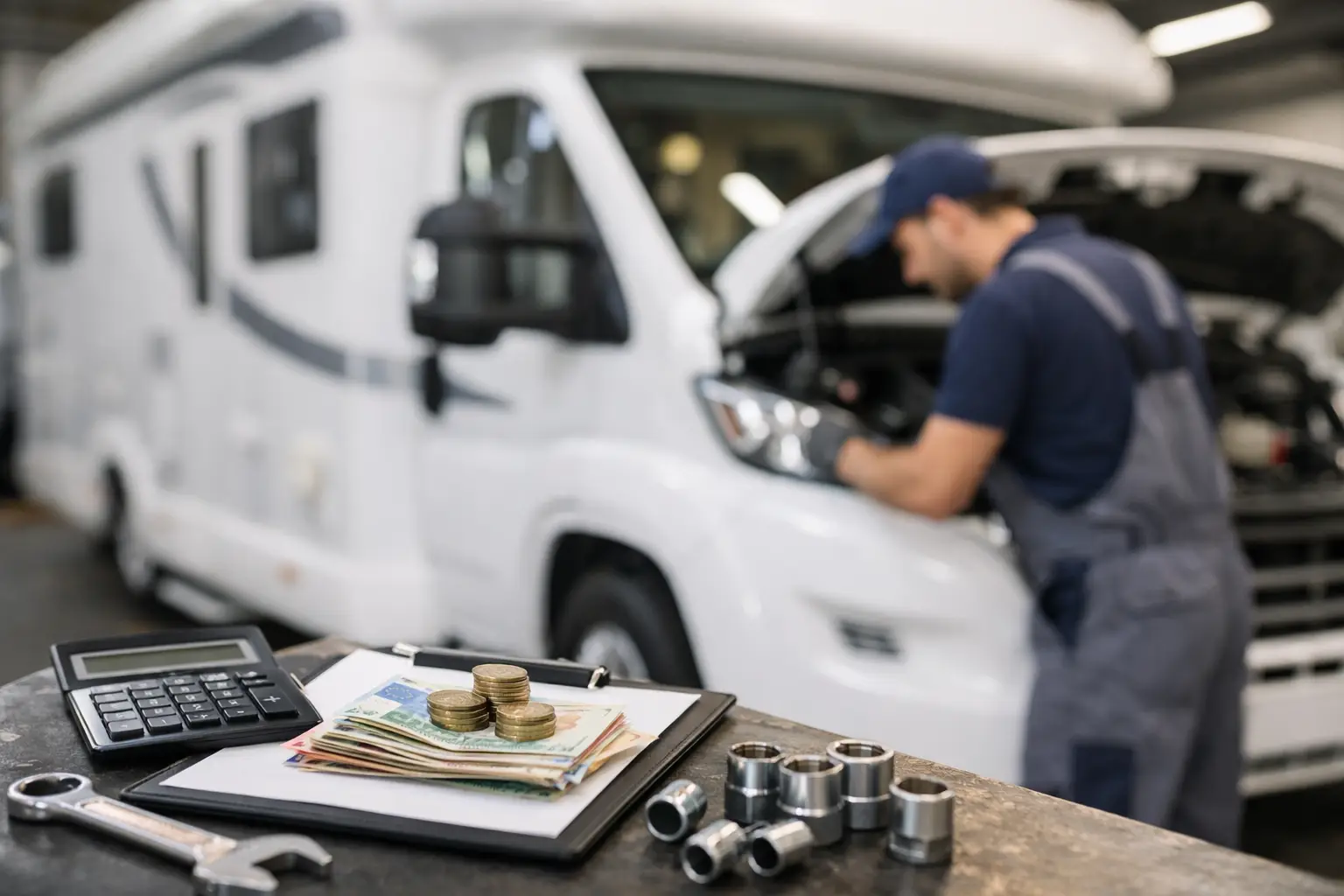
A weekend on the Moselle, two weeks heading for Italy or a family holiday on the North Sea – a motorhome is meant to bring freedom, not suddenly drain your travel budget. If you plan maintenance costs realistically from the start, you set off more relaxed and protect the value of your vehicle at the same time. Regular care is usually much cheaper than a repair that only shows up on the road.
How high the expenses really are depends on age, mileage, body, drive technology and how much you can do yourself. For a well-kept motorhome, you should budget on average roughly €500 to €1,500 a year for servicing, inspections and the usual wear parts. In years with major services, new tyres or a timing belt due, it can be noticeably more.
Motorhome maintenance: the main items
A motorhome is at once a base vehicle, living space and technical installation. Maintenance is therefore made up of several areas. Not every item arises every year, but all belong in a realistic cost plan.
The classic service of the base vehicle follows the manufacturer's specifications. For many panel vans, semi-integrated and fully integrated models, it is due annually or after a certain mileage, depending on the model. Oil, oil filter and visual checks are often part of it. Budget roughly €350 to €700 for this. If air, fuel or cabin filters are added, the amount goes up.
With a diesel engine, AdBlue, brake fluid, coolant and air-conditioning servicing can also become relevant. What is really necessary is decided not by gut feeling but by your vehicle's service schedule. If you put these appointments off for a long time, you risk not only consequential damage but possibly also problems with warranty or goodwill cover (Kulanz).
The habitation check is often underestimated
The living area needs its own attention. The fresh water system, waste water tank, heating, fridge, battery, windows, roof vents and electrical appliances only work reliably if they are checked regularly. A check of the body costs, depending on scope, often between €150 and €400.
The leak test (Dichtigkeitsprüfung) is particularly important. It checks the roof, windows, flaps, transitions and sealed seams for possible moisture. Depending on the manufacturer and vehicle size, the cost is usually around €120 to €250. On newer vehicles, the record is often a requirement for keeping the leak-proof warranty. On older motorhomes the test also makes sense, because unnoticed water ingress can cause expensive damage to walls, floor and furniture.
Gas, TÜV and inspections
A regular gas inspection is mandatory for the liquefied gas system in a motorhome. It is generally due every two years and often costs around €40 to €80. Among other things, it checks gas pipes, pressure regulators, shut-off devices and connected appliances such as the heater or hob. A working gas system is not a question of comfort but a safety factor.
The TÜV inspection (Hauptuntersuchung) also needs planning every two years, for new vehicles first after three years. Depending on weight class and scope, the fees are usually around €150 to €220. If a defect is found, a re-inspection and repair costs come on top. It is practical to bundle the inspection, gas check and upcoming workshop jobs sensibly. That saves trips and prevents an appointment in your travel month from suddenly becoming a brake on your plans.
Wear parts: this is where the biggest differences arise
Ongoing maintenance is easy to calculate. Wear parts are less predictable, because driving style, load, periods standing and route profile make a lot of difference. A fully loaded motorhome puts considerably more weight on the road than a car. That puts correspondingly more strain on tyres, brakes and suspension.
Tyres are among the biggest single items. A complete set can cost, including fitting, roughly €700 to €1,400, depending on tyre size and load rating. Even if the tread still looks decent: with motorhome tyres, age plays a big role. Many vehicles stand for a long time, and the material gets harder over the years. Visible cracks, imbalance or a high tyre age are good reasons for an expert check.
Brake pads and brake discs together can quickly cost €500 to €1,200, depending on the axle and vehicle model. With motorhomes that are rarely moved, wear is not the only issue. Corrosion on brake discs, seized brake calipers or a weak starter battery often arise precisely from long periods standing. Regular movement and suitable battery care avoid some surprises.
The timing belt also deserves attention, if your base vehicle has one. The replacement interval depends on age and mileage. Depending on the engine, roughly €800 to €1,500 may be due. This is not an appointment to postpone: a snapped timing belt can cause serious engine damage.
What does motorhome maintenance really cost per year?
For your personal planning, it helps to look at several years rather than just the next invoice. A younger motorhome with no acute need for repair often gets by in a normal year with €600 to €1,000. That can include the service, habitation check, minor materials and a share of inspections.
For an older vehicle or high annual mileage, €1,000 to €1,500 is more realistic. This then includes, for example, more extensive service work, brakes, battery or first repairs to the living technology. A year with new tyres or a timing belt can push the total to €2,000 and more.
These figures are guideline values, not flat-rate prices. A compact panel van with little technology is generally cheaper to maintain than a large integrated motorhome with levelling jacks, solar technology, air conditioning and extensive electrics. More comfort means more possibilities on the road – and more components that need looking after.
Running fixed costs such as insurance, vehicle tax, parking space or financing do not belong in this maintenance calculation. Repairs after accidents and accessory wishes such as an awning, bike rack or lithium battery are also separate decisions. With retrofits in particular, it is worth clarifying beforehand whether the existing electrics, payload and use of the vehicle fit.
How to keep maintenance costs plannable
The best approach is to set aside a fixed amount for your motorhome every month. For a younger vehicle, €60 to €90 a month can be a good start, for an older model more like €100 to €150. That way the budget is ready when the service, the gas inspection or a set of tyres comes up.
A well-kept service book and properly documented invoices pay off twice. You keep track of deadlines, can plan servicing better and build the trust of potential buyers when you sell later. If you are buying a used motorhome, ask especially carefully: when were the oil change, timing belt, leak test, gas inspection, brake service and tyre change last due?
You can do simple things yourself, such as caring for seals, checking tyre pressure, cleaning the fresh water tank and visually checking roof vents or cables. For gas, brakes, moisture, electrics and safety-relevant components, however, the vehicle belongs in expert hands. Otherwise a supposed saving can become expensive.
Servicing before the trip instead of repairs on holiday
Before a longer tour, a short seasonal check is worthwhile. Check fluid levels, lighting, tyre pressure, battery, windscreen wipers and the function of the heating, fridge and water supply. If you want to set off early in spring, don't ask for a workshop appointment only shortly before Easter. In peak season, free capacity is often taken quickly.
At Friedas Camper in Kempen, servicing, repairs and sensible retrofits can be arranged in one place. That is particularly convenient if you don't just want to fix a single fault but have your motorhome given a thorough once-over before your next trip.
A well-maintained motorhome is not a money pit but a reliable travel companion. Plan the appointments early, keep an eye on the paperwork and give your vehicle the care it needs for many relaxed kilometres.