Retrofitting a Motorhome Solar System Made Easy
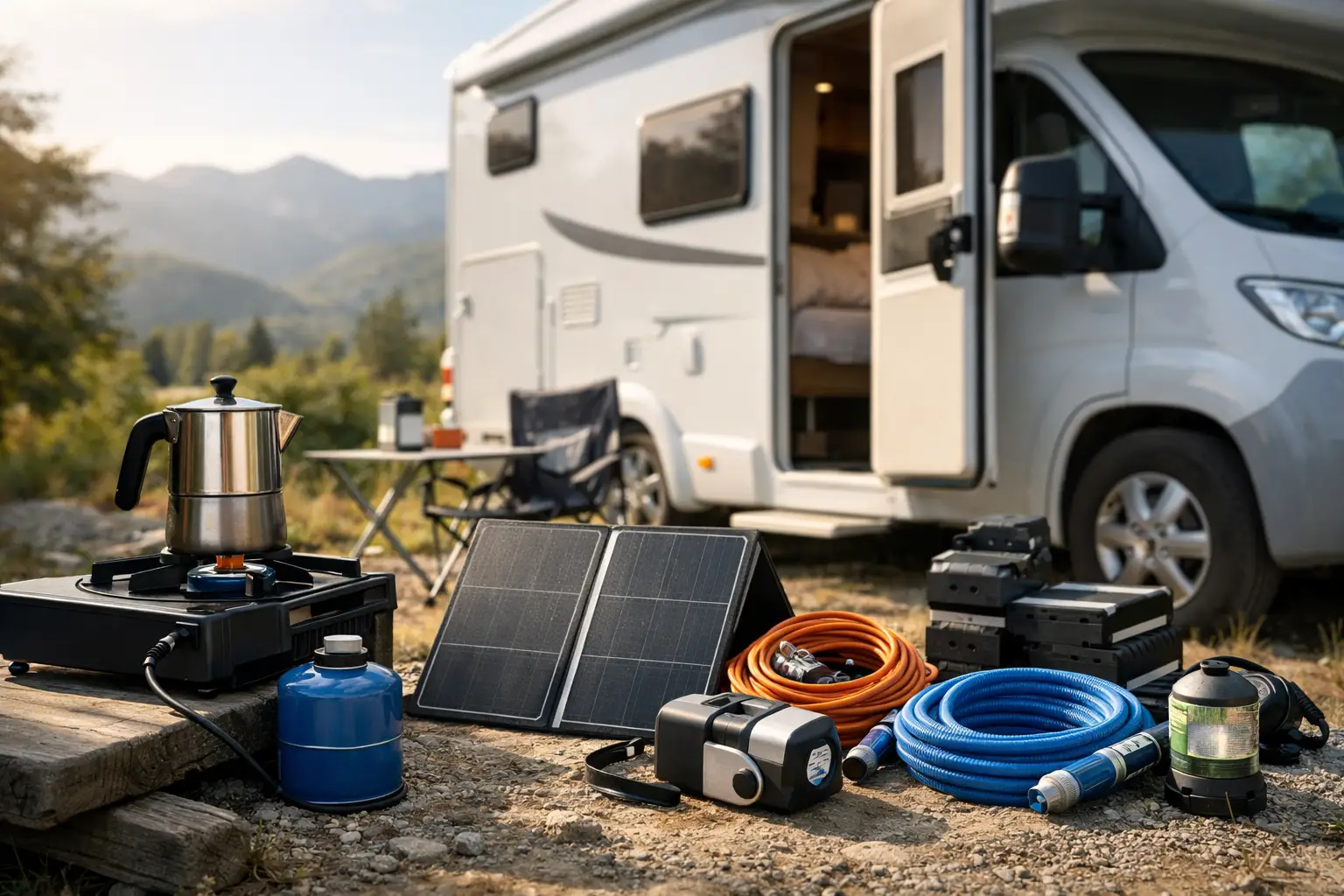
If you want to make coffee in the morning far from a campsite, switch on the light and keep an eye on the leisure battery, you can retrofit a solar system to your motorhome. It doesn't turn the motorhome into a completely self-sufficient house on wheels – but it noticeably reduces your dependence on mains hook-up. Especially for weekends by a lake, pitches without a power post or longer tours south, it is a gain in comfort that you notice quickly.
What matters is not putting as much output as possible on the roof. A good solar system suits the vehicle, the existing electrics and above all the way you travel. Someone who only occasionally stays a night off-grid has different needs from a family with a compressor fridge, a laptop and several smartphones.
When is it worth retrofitting a solar system to a motorhome?
A retrofit is particularly sensible if you often stay independent, or don't want to head for a campsite with an electric hook-up every evening on your travels. During the day the solar panels charge the leisure battery and so supply the usual 12-volt consumers: lighting, water pump, USB sockets, heating electronics, TV or fridge control.
Solar can help during standing periods too. A vehicle parked outside the door for several weeks benefits when the leisure battery is topped up regularly. However, this requires the system, battery and wiring to be properly matched to one another.
A large system is less suitable if the motorhome is used almost exclusively on campsites with mains hook-up, or if you travel mainly in winter. With the sun low in the sky, short days, shade and snow, the yield is much lower. Solar is a valuable addition, but does not replace a mindful approach to energy.
Estimating your own power needs realistically
Before choosing, there is a simple question: what in your motorhome really runs off the leisure battery? An LED lamp uses hardly any energy. A compressor fridge, on the other hand, works regularly, and an inverter for a coffee machine or hairdryer draws a lot of power. Heating, satellite system, chargers and an electric step also belong in the calculation.
As a rough guide, about 150 to 200 watts of solar output is enough for many couples who stay off-grid for two to three days in summer. Families, travellers with high media needs or users of a compressor fridge are often better off with 250 to 400 watts. On a panel van the available roof area is often more limited than on a semi-integrated motorhome. So it is not only the desired output that counts, but also a sensible place for the panels, roof vents, air conditioner and satellite antenna.
Important: watts on the panel are not the same as daily yield. Weather, season, orientation, shading and dirt all play a part. The shadow of a branch over part of the surface can noticeably reduce output. So plan with a reserve instead of calculating a system to the limit.
The battery is part of the planning
A solar system can only store energy if the battery suits it. Older AGM or gel batteries can usually still be used, but have less usable capacity and a higher weight than modern lithium batteries. If you want to travel off-grid regularly, you therefore often think about combining a solar panel with a lithium battery.
This is not automatically necessary for every vehicle. An intact AGM battery can be perfectly adequate for occasional trips. With lithium, the charge booster, charger and solar controller must match the battery technology. This is exactly where a professional check prevents wrong purchases and ensures the system works reliably in the long term.
Components a solar system needs
A complete system consists of more than one panel on the roof. In addition to the solar panel, it includes a charge controller, suitable cable cross-sections, fuses, a roof feed-through and mounting material. Depending on the setup, a battery computer or a display for monitoring yield is added.
The charge controller is the link between panel and battery. In modern systems, an MPPT controller is usually the better choice. It uses the available panel output more efficiently than simple PWM controllers, especially in changing light conditions. It costs a little more, but can be worthwhile where roof space is limited.
For the panels, there is usually a choice between rigid glass panels and flexible versions. Rigid panels generally deliver good output, are durable and can be securely fixed to many roofs. Flexible panels are lighter and flatter, but depending on quality, heat build-up and method of fitting may have disadvantages in durability and yield. For a classic motorhome, a high-quality rigid panel is often the solid solution.
Retrofitting a solar system to a motorhome: installation with a plan
Installation begins with a look at the roof. Where do the reinforcements run? Which roof fittings are already there? Where can the panel sit as free of shade as possible, without blocking service hatches, roof windows or manoeuvring routes? The cable route into the vehicle must also be settled beforehand.
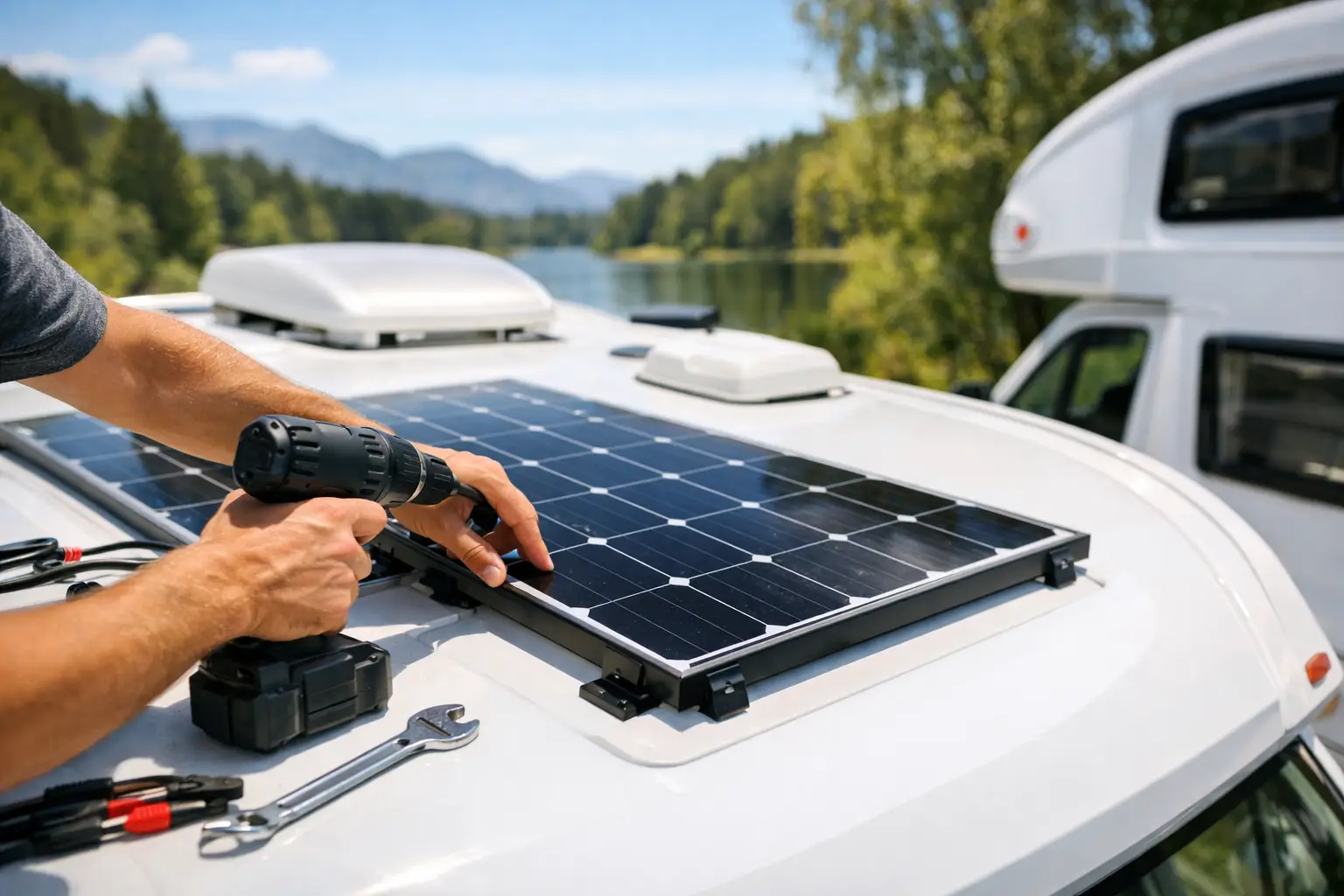
Depending on the roof material, the panels are fitted with spoilers, brackets and a suitable adhesive or fixing system. Clean work is decisive here: the roof must be prepared, the bonding surface must be right and the roof feed-through must be permanently watertight. A leak is not always noticed straight away – but can later cause moisture damage in the roof and interior fittings.
Inside, the solar controller is fitted as close to the leisure battery as possible. The cables are fused and routed so that they are protected against chafing, heat and moisture. If you are also planning an inverter, a charge booster or a second battery, you should look at the whole onboard electrical system as one system. Installing individual components bit by bit seems cheaper at first, but sometimes leads to unnecessary rebuilds.
For very experienced DIY campers, installing it yourself is possible. But if you are unsure about 12-volt electrics, roof sealing or battery technology, you are better off with workshop installation . A professionally fitted system saves time, protects the value of the vehicle and gives you confidence on the road. At Friedas Camper in Kempen, the Retrofit can be planned and carried out to suit your vehicle and travel profile – all from a single source.
What does the retrofit cost?
The costs depend on output, battery, vehicle and installation effort. For a simple system of around 150 to 200 watts with an MPPT controller and professional fitting, you should roughly expect a mid three-figure to low four-figure amount. More output, complex cable routes, a battery computer or conversion to lithium increase the budget.
The cheapest kit is not always the most economical decision. Inferior cables, unsuitable adhesives or poorly matched controllers can cause more work later than a properly planned solution. Have it explained to you transparently in advance which components will be fitted and why they suit your motorhome.
Getting more out of the system on the road
Solar power is only produced when light hits the panels. So, if possible, don't park permanently under dense trees. Even a narrow strip of shade from a roof box, antenna or branch can reduce the yield. Clean the panels occasionally with water and a soft cloth – dust, pollen and bird droppings are part of camper life.
Even more important is a look at consumption. Charge energy-hungry devices preferably during the day, when the sun is supplying power. An inverter for household appliances should be used consciously. Kettles, hairdryers or high-output coffee machines put considerable load on the battery and are rarely the best choice when staying off-grid.
A battery computer brings clarity. It shows not only the voltage, but also inputs and outputs, state of charge and consumption. That makes it much easier to gauge your own energy budget on the road – especially when several people are travelling in the vehicle.
Frequently asked questions about solar retrofits
Does solar also charge while driving?
Yes, with sunshine the solar system also charges while driving. For fast battery charging, however, the alternator via a suitable charge booster is often more effective. The two complement each other well.
Is solar enough for the fridge?
That depends on the type of fridge. A compressor fridge runs on 12 volts and can be well supplied with enough solar output and battery capacity. An absorption fridge is usually run on gas when staying off-grid, because running it on electricity can require considerably more energy.
Is the starter battery charged too?
Not every system charges the starter battery automatically. With a suitable maintenance charger or a corresponding system solution, it is possible. Clarify this wish before installation, so that the wiring and components are designed for it from the start.
Above all, a solar system creates one thing: more room for manoeuvre. When output, battery and installation suit your travel style, you can choose the pitch for its view rather than its power post – and drive on in the morning with full energy.